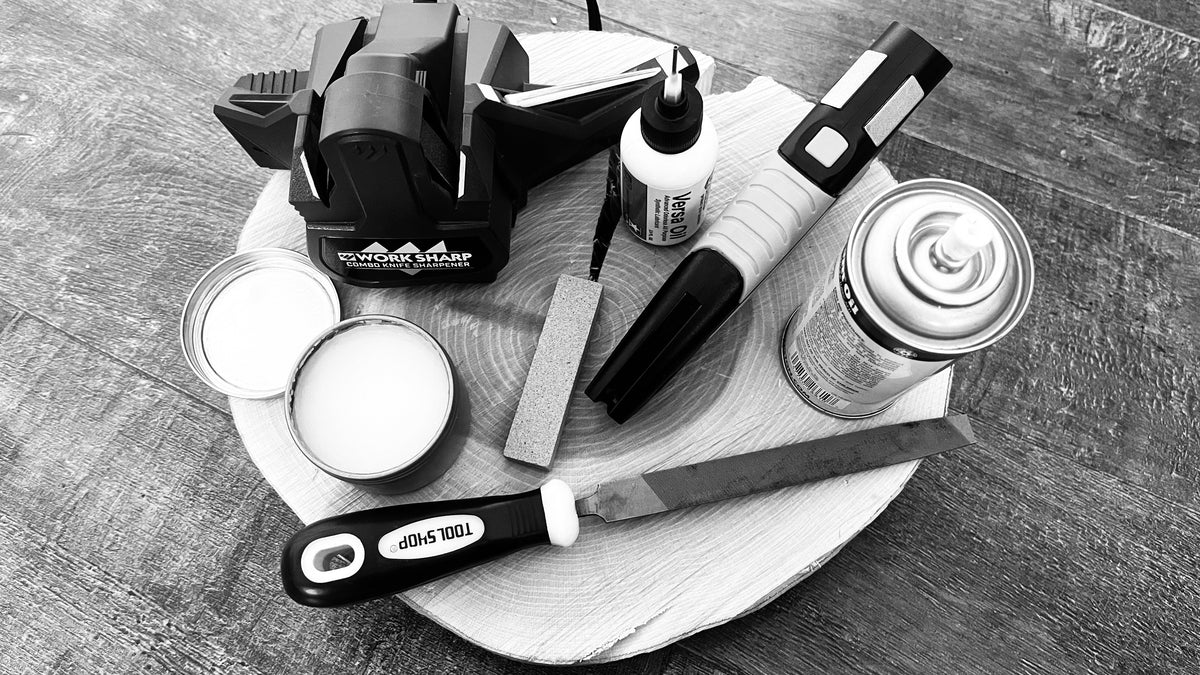
A quality EDC knife is an investment. Same as with any other tool or machine, a well maintained knife is a knife that will always be happy and ready to perform. Maintenance can mean many things, depending on the type of knife, blade steel, and type and frequency of use.
Knife maintenance is not complicated, but ideally it would happen consistently. This guide covers everything you need to do, how often to do it, and the specific products and techniques that actually work.
Cleaning Your Knife
Pocket lint, dust, food particles, blood, sap, and general grime accumulate in the pivot area and handle recesses of any folder you carry regularly. This debris affects the action — the smoothness of opening and closing — and can accelerate wear on the pivot and lock mechanism if left to build up.
Basic cleaning (monthly for regular carry): Wipe down the blade and handle with a clean cloth. Use a toothpick or compressed air to clear debris from the handle recesses, the area around the pivot, and the inside of the pocket clip. Open the blade fully and wipe down both sides. This takes two minutes at most and makes a meaningful difference in maintaining action quality.
Deep cleaning (every three to six months, or when the action becomes gritty): Disassemble the knife if you are comfortable doing so. Most folding knives use Torx screws — T6 and T8 are the most common sizes — and can be taken apart with a quality driver set. Clean all internal surfaces with isopropyl alcohol on a cotton swab. Pay particular attention to the pivot, the lock interface, and any areas where metal contacts metal. Allow everything to dry completely before lubrication and reassembly.
If you are not comfortable disassembling your knife, a can of compressed air and a toothpick can clear most debris without disassembly. You can also run warm water over an open knife to flush debris, then dry it thoroughly and re-lubricate before any moisture has a chance to cause issues. Do this only with stainless steel knives — carbon steel or D2 should be dried and lubricated immediately if rinsed with water.
After hunting or field use: Blood, fat, and moisture are the enemies of blade steel and pivot performance. Wipe the blade clean immediately after use, apply a thin coat of oil, and clean the pivot area before you store the knife. This is especially important with D2 steel, which is not fully stainless and will rust if left in contact with blood or moisture overnight.
Lubricating Your Knife
Lubrication serves two purposes: it reduces friction at pivot and lock contact points, keeping the action smooth, and it protects metal surfaces from corrosion. The right lubrication applied in the right places makes a significant difference in both performance and longevity.
Where to lubricate:
- The pivot: One small drop of oil directly on the pivot — the screw or pin around which the blade rotates. Work the blade open and closed several times to distribute the lubricant, then wipe away any excess that migrates onto the blade or handle.
- The lock interface: A very light application of lubricant where the lock contacts the blade tang, a thin wipe with an oiled cloth is sufficient.
- The blade: A thin wipe of oil or even better, premium blade wax on the entire blade surface protects against corrosion, particularly at the edge and in the area near the pivot where moisture and debris accumulate.
What lubricant to use: Several products work well. Nano-Oil is a synthetic lubricant specifically formulated for knife pivots and is widely used by serious enthusiasts. Rem Oil and Break-Free CLP are widely available gun lubricants that work adequately on knives. Blade wax is another specialty and purpose driven lubricant and protectant perfect for a thing coating on your blade, and is available in food safe forms.
How much lubricant: Less than you think. A single small drop on the pivot is correct. More than that will migrate onto surfaces where you do not want it — the handle, the pocket, your hands. A light wipe on the blade is correct. A heavy coat will feel greasy and attract debris. The goal is a thin, even protective film, not a visible liquid coating.
Sharpening: When and How
Knowing when to sharpen is as important as knowing how. Many people sharpen too aggressively and too often, removing more steel than necessary and shortening the knife's useful life. The goal of routine maintenance is to extend the time between full sharpenings, not to substitute for them.
Stropping (weekly for regular carry and use): A leather strop loaded with polishing compound — or even an unloaded piece of smooth leather — can realign the edge without removing significant steel. When a blade feels slightly less than razor-sharp but still cuts cleanly, a few passes on a strop brings it back. This is maintenance, not sharpening. Do it regularly and you will sharpen far less often.
Touch-up sharpening (when stropping is no longer sufficient): When a blade has visible edge damage, struggles on paper, or feels noticeably dull rather than just slightly rolled, it is time for a sharpening. For premium steels like MagnaCut, S35VN, or D2, use a diamond stone or quality ceramic rod. Start at a finer grit than you think you need — most edge touch-ups do not require coarse grinding. Work at a consistent angle (17–20 degrees per side is the standard for most EDC folders), alternating sides, until you feel a burr forming on the opposite side. Then work the opposite side until the burr transfers back. Finish on your finest grit and strop.
Full reprofiling (when the edge is badly damaged or very dull): If a knife has been used hard, dropped on a hard surface, or was never properly sharpened from the factory, a full reprofiling on a coarser stone may be necessary. This removes more steel and takes more time. If you're not comfortable doing this yourself, a local knife sharpener or a mail-in sharpening service is a reasonable option rather than risking the edge geometry on a knife you have invested in.
Sharpening angle: Most quality production folders are set at 17–20 degrees per side from the factory. Thinner is sharper but more fragile. Thicker is more durable but less sharp. For general EDC use, 18–20 degrees is a good balance. For hunting knives that will face tougher use, 20–22 degrees adds durability. Try not to guess — a consistent angle matters far more than the exact angle you choose, this is where sharpening guides can really help.
Maintaining the Pocket Clip
The pocket clip sees constant friction against pocket fabric and accumulated grit that can scratch the knife finish and loosen the clip screws over time. Check the clip screws periodically and retighten if they have backed out — a loose clip is both annoying and can allow the knife to fall from your pocket. A very small drop of blue Loctite on the threads prevents backing-out without making future removal difficult.
Clean the clip channel — the space between the clip and the handle — with a toothpick and isopropyl alcohol. Lint accumulates there and can abrade the clip and handle finish over time.
Storage
If you are storing a knife that will not be carried regularly, wipe it down with a lightly oiled cloth before storage, close the blade, and store it in a dry environment away from moisture. Do not store knives in leather sheaths long-term — leather retains moisture and can cause rust on carbon steels and even spotting on stainless. A cloth pouch or simple dry storage is better for medium or long-term storage.
A well-maintained knife carries better, performs better, and lasts longer than one that is neglected. The time investment is minimal — a few minutes a month for most regular carry knives — and the return is a knife that performs reliably every time you reach for it.