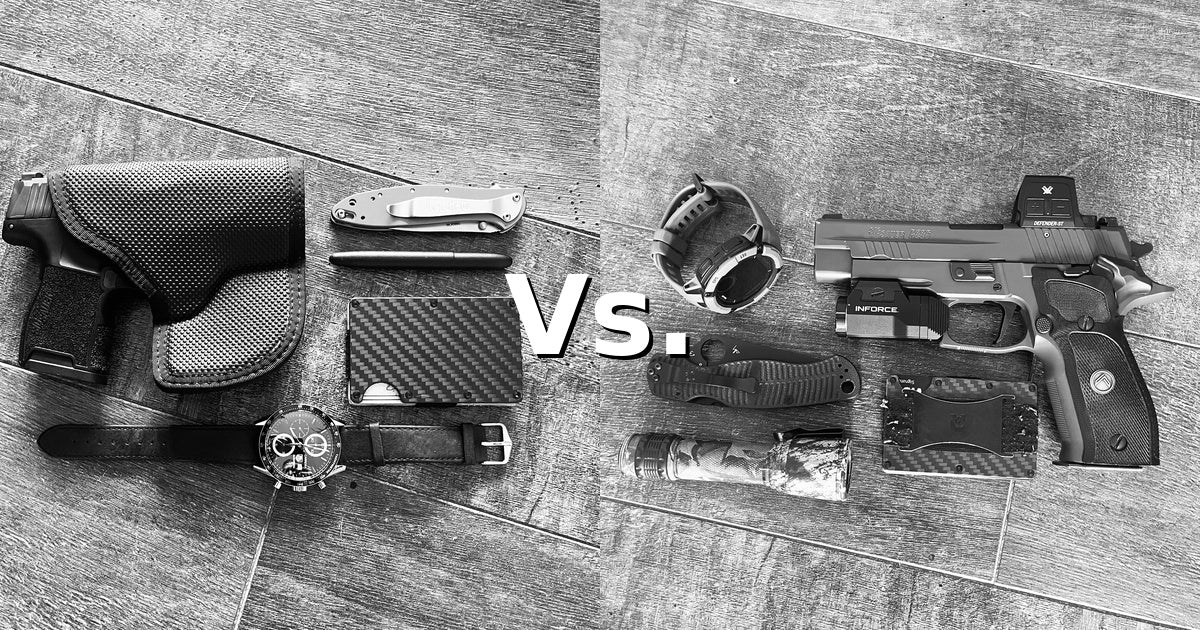
Ask ten people what every day carry means to them and you will get ten different answers. For one person it's a slim, polished folder that disappears into some chinos or dress pant pockets and looks at home in a boardroom. For another it's a beat-up workhorse clipped to a belt loop that's opened ten thousand boxes and cut everything from zip ties to rope to drywall tape. Both are right, and that's the point!
EDC — every day carry — is not a product category. It's a philosophy about intentional preparedness. The idea that the tools you carry with you shape what you're capable of doing when situations arise unexpectedly. A knife is the most fundamental of those tools (and actually one of humanity's oldest tools), and the right knife looks completely different depending on who is carrying it and why.
The Trades: Construction, Electrical, and Plumbing Work
If you work in construction or a skilled trade, your knife is a tool first and everything else second. It will cut sheathing, score drywall, strip wire insulation, slice caulk tubes, open material bags, cut rope and cord, and occasionally be asked to do things a knife was never quite designed for. It will get dirty, dropped, and sometimes (not that YOU would ever do this) used as a pry point by someone who should know better.
For this role, you want a tough steel that is easy to sharpen quickly on a job site — AUS-8 or D2 are both reasonable choices. You want a handle with aggressive texture that does not slip in a gloved hand. You want a reliable lock that will not disengage under lateral pressure. And you want something that you're genuinely comfortable putting to work without babying it.
The blade shape matters too. A drop point or modified clip point is the most versatile geometry for trade work — it handles scoring, slicing, and detail cuts without the limitations of more specialized shapes. A blade length around 3.5" seems to be ideal, or even slightly longer to give you enough cutting surface for larger material cuts.
Style for this context means something different than it does in an office. A matte finish that doesn't show wear, a clip that stays secure through physical work, and a size that feels proportionate in a larger hand are all practical style considerations. This is not the place for a polished titanium framelock — it's the place for something that looks like it belongs on a job site...because it does.
Warehouse and Logistics: The Box Opener
If your working day involves breaking down cardboard, cutting strapping, slicing tape, and processing incoming shipments, you have different requirements than a tradesperson. Here the premium factor is blade retention on a cutting edge against a highly abrasive material — cardboard is surprisingly destructive to a blade.
This is one context where replaceable blade knives genuinely shine if you don't want to have to continually resharpen your blade and are OK with a generally less than premium feeling knife. There are multiple options for scalpel-grade replaceable blades that stay surgical-sharp through heavy use, then swap out in seconds when they dull. No sharpening, no maintenance cycle, just consistent performance. For production cutting environments, that is hard to beat.
A Wharncliffe blade shape — flat spine, straight edge curving to a point — is ideal for box cutting because the straight edge maximizes contact with the material and the low tip angle minimizes the risk of puncturing the contents. Several manufacturers offer specifically designed box-cutting folders with this geometry. Our primary "beater Knife" offering has a Wharncliffe blade, check out the post to learn about our Beater Knife program!
In a professional environment, the style consideration is also practical — you want something that looks purposeful rather than aggressive. A blade that passess as a utility tool rather than a tactical knife is appropriate for shared workspaces and helps avoid unnecessary conversations.
Hunting and Field Work
A hunting knife has the most specific performance requirements of any EDC context. You will be processing game in wet, cold conditions, often with gloved hands, needing to maintain a controlled cutting motion through hide, fat, and connective tissue for extended periods. Your blade will be exposed to blood, moisture, and harsh conditions throughout. And it needs to stay sharp long enough to finish the job. On top of this, if you're a backcountry hunter (as we are!), your knife will be living in these less than ideal conditions for the entirety of your hunt and if you're fortunate enough, likely processing your game as well as your hunting partners.
This is where steel choice matters most. D2 holds an excellent edge but can stain and rust under hunting conditions if not wiped down regularly. S35VN handles moisture better and maintains its edge well through skinning work. CPM MagnaCut — the steel in many of our in stock knifes — was specifically engineered for exactly this scenario. Outstanding corrosion resistance, excellent edge retention, and the toughness to handle a full field-dressing job without chipping on unexpected bone contact.
A drop point blade is the standard hunting geometry for a reason. The rounded tip prevents accidental puncture of the gut cavity during field dressing while providing a long, curved belly for skinning passes. A 3.25" to 4" inch blade gives you adequate length for larger game without being unwieldy for detail work around joints.
Lock security matters more here than in almost any other context. Cold, wet, bloody hands and a blade under cutting pressure is exactly the situation where a marginal lock becomes a safety issue.
Camping and Outdoor Recreation
Camping and outdoor recreation occupies a middle ground between the utility demands of hunting and the everyday carry requirements of urban life. You need a knife that handles food prep at camp, processes kindling, cuts cord and webbing, and handles general camp tasks — while still being appropriate and legal to carry during travel and in mixed company.
Here a folding knife between 3" and 4" hits the right balance. Large enough for real camp utility, compact enough to not dominate your kit. A full flat grind excels at food prep and general slicing. A drop point blade handles camp tasks without the limitations of more specialized shapes.
For camping, steel durability and ease of sharpening in the field matter more than absolute edge retention. You're more likely to have a simple ceramic rod in your kit than a complete diamond stone progression, so a steel that responds well to quick touch-ups — S35VN, VG-10, AUS-8 — is practical.
Style in the outdoors context means durability of finish and compatibility with the gear aesthetic. Earth tones, matte finishes, and natural handle materials like G10 in olive or brown all work, but you might want something a bit more flashy or eye catcing (like blaze orange or neon green) to help quickly spot your knife when you inevitably drop or set it down in the grass or forest floor. A knife that photographs well at camp and fits the overall outdoor kit aesthetic is a good consideration when you're making a deliberate gear choice.
Office and Professional Environments
The office EDC knife is perhaps the most design-constrained of any context. You need a blade long enough to be genuinely useful — opening packages, cutting string, food prep at lunch — while being short enough and handled in a way that does not make colleagues notice or question why you're carrying it. You need a deployment method that is fast enough to be practical but not so aggressive that it reads as tactical.
A 2.5" to 3.25" blade in a slim framelock or slipjoint is the sweet spot for office carry. The Spyderco Para 3 Lightweight at 2.93" occupies exactly this space — substantial enough to be useful, compact enough to not attract attention. A slipjoint with no visible lock is even less noticeable for highly conservative environments.
Handle material and finish matter enormously here. Titanium with a stonewashed finish, carbon fiber, or polished wood all carry more easily in professional environments than aggressive G10 texturing or tactical-looking hardware. The goal is a knife that reads as a quality everyday tool rather than a weapon.
The Right Knife for Your Life
Every day carry is deeply personal because the demands of every day vary so significantly from one person to the next. The best EDC knife is not the one with the highest rating or the most premium steel (although we're big fans of MagnaCut blades...in case you haven't caught on yet) — it's the one that fits your actual daily demands, your physical environment, and the contexts in which you carry it. This varies so much from person to person, or even from day to day for the same person...so why settle for just one solid EDC knife?
If you are not sure which category fits your life best, reach out. Matching the right knife to the right person is one of the things we genuinely enjoy doing here at EDCustoms. If we don't have a brand or item listed, we can most certainly order it for you at a price that will be worth the extra couple of days wait.