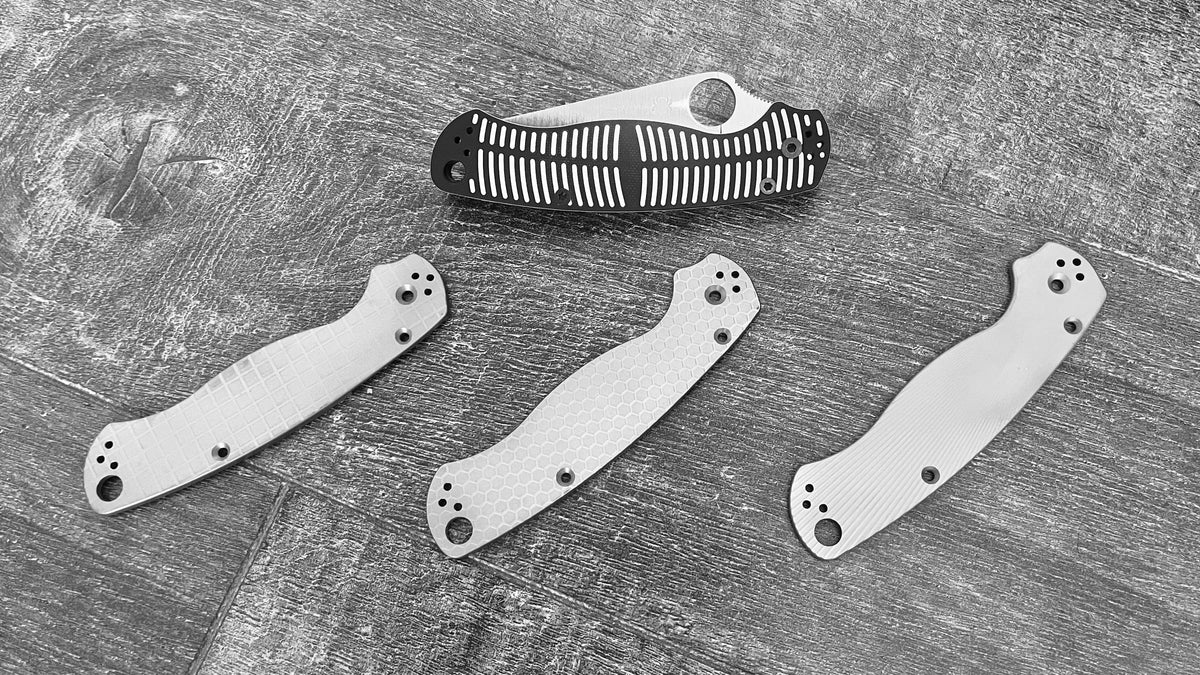
Your knife came from the factory with perfectly functional handles. So why do thousands of EDC enthusiasts swap them out for titanium scales within months of buying a new knife? And why do the aftermarket scale makers charge $80 to $150 for what is essentially a pair of handle slabs?
The answer involves weight, feel, durability, corrosion resistance, and something harder to quantify — the satisfaction of carrying something that is genuinely yours. This guide covers everything you need to know about titanium scales before you buy.
What Are Knife Scales?
On a folding knife, the scales are the two outer slabs that form the handle — what your hand actually grips. They attach to the knife's internal frame or liners and are held in place by pivot hardware and standoffs. On many popular EDC knives, the factory scales are made from G10 fiberglass, FRN (fiberglass-reinforced nylon), aluminum, or various synthetic materials. These work well and are cost-effective at scale for manufacturers.
Aftermarket scales replace those factory slabs with alternatives made from different materials, with different textures, finishes, and sometimes different geometries. Titanium is by far the most popular premium material for aftermarket scales.
Why Titanium?
Titanium — specifically Grade 5 titanium, also called Ti-6Al-4V — has a combination of properties that make it nearly ideal for knife handles...It's no coincidence that this is the titanium that we use in our EDCustoms scales!
Exceptional strength-to-weight ratio
Titanium is approximately 45% lighter than steel but nearly as strong. A pair of titanium scales will typically weigh less than the factory G10 slabs they replace while being stronger and more rigid.
Superior corrosion resistance
Titanium is effectively immune to rust and corrosion in virtually all environments including salt water. For anyone who carries near water, sweats heavily, or works in humid or corrosive environments, titanium handles will outlast any steel component on the knife.
Anodization — color without paint
This is where titanium gets genuinely interesting. Titanium can be anodized — an electrochemical process that grows a transparent oxide layer on the surface. Different oxide layer thicknesses refract light at different wavelengths, producing different colors. No dyes or pigments are involved. The color is structural, meaning it cannot chip, flake, or peel. Common anodization colors include blue, purple, gold, green, bronze, and teal, and skilled anodizers can produce multicolor patterns and gradients. It is permanent in normal use.
In-hand feel
This is difficult to describe but impossible to ignore once you have felt the difference. Machined titanium has a distinctive warm, dense, slightly grippy feel that synthetic materials have a hard time replicating. Stonewashing and bead-blasting textures add grip without being abrasive. Many people who switch to titanium scales report that the knife simply feels better to carry and use.
Longevity
A quality pair of titanium scales will outlast the knife they are on. There is nothing to wear out, fade, crack, or deteriorate. Many collectors treat scales as long-term investments that can be moved to replacement knives of the same model years down the road.
Common Finish Options
When shopping for titanium scales you will encounter several finish descriptions. Here is what they mean in practice.
Stonewashed
The scales are tumbled with media that creates a matte, slightly textured surface with fine random scratches. Stonewashing hides fingerprints and minor wear extremely well, making the knife look good even after hard use. It is the most popular finish for working carry knives.
Bead blasted
A uniform matte finish produced by blasting the surface with fine glass or ceramic beads. Slightly smoother than stonewash, hides fingerprints well, provides a consistent look.
Anodized
Any of the above finishes can be anodized to add color. Blue and purple are the most common, but skilled anodizers offer dozens of color options and with skill and time can slo hand-anodize scales with swirl or gradient patterns that are unique to each set.
Raw machined / brushed
The natural silver finish left by machining, sometimes with directional brush marks. Shows the metal in its most natural state. Fingerprints show more than on stonewashed finishes.
Polished
A mirror-bright finish. Visually striking but shows fingerprints instantly and can be slippery. Less common for working knives, more common for display or collector pieces.
Which Knives Have Aftermarket Titanium Scales?
The aftermarket scales industry is driven by the popularity of specific knife models. The most supported models — meaning the widest selection of scale options from the most makers — include the following.
Benchmade Bugout 535
The Bugout is one of the most popular EDC folders ever made, and its simple liner-lock design makes it a natural candidate for scale swaps. The factory MOLLE-textured nylon scales are functional but divisive aesthetically. Titanium scales for the Bugout typically run $80–$120 and dramatically change the look and feel of the knife. Weight adds slightly since the factory scales are extremely light, but the improvement in hand feel and grip security is substantial for most users.
Spyderco Para Military 2
The PM2 is arguably the most customized knife in the EDC community. Dozens of makers produce titanium scales for it in every finish and color imaginable. The PM2's G10 factory scales are excellent, but titanium takes the knife from a great tool to a genuinely premium piece. The full-size handles give the scales substantial presence in the hand. Typical pricing runs $90–$150.
Spyderco Para 3
The smaller sibling to the PM2, the Para 3 has nearly the same scale compatibility with many makers producing scales for both simultaneously. Titanium scales on the Para 3 are popular among those who want a more compact carry with premium feel. Typical pricing $80–$130.
Other well-supported models
Benchmade Griptilian, Spyderco Delica and Endura, Kershaw Blur, Zero Tolerance 0562, and various Chris Reeve Knives models also have active aftermarket scale communities, though with fewer options than the top three above.
What to Check Before Buying
Not all titanium scales are created equal. Here is what to look for.
Machining tolerance
The scales need to fit your specific knife precisely. Reputable makers test their scales on actual production knives and specify which generation or variant of a model the scales are designed for. Some models have changed slightly between production runs and scales designed for earlier versions may not fit perfectly on newer ones. Check the maker's compatibility notes carefully.
Grade 5 vs Grade 2 titanium
Grade 5 (Ti-6Al-4V) is significantly stronger and harder than Grade 2 commercially pure titanium. For knife scales, Grade 5 is the right material. Most reputable makers use Grade 5 (as do we in our EDCustoms scales) — if a listing does not specify, ask.
Fit & Finish
At EDCustoms we vet the scales we carry in our EDCustoms product line for fit, finish, and material quality.
Installation
Swapping scales on most folding knives is straightforward but requires care. You will need:
- A quality set of Torx drivers (T6, T8, and T10 are the most common sizes for folding knives)
- A clean, flat work surface
- A small container to hold hardware so nothing rolls away
- 15–30 minutes and patience
The general process is to remove the clip, disassemble the scales by removing the screws and standoffs, swap to the new scales, and reassemble. Torque matters — overtightening screws can crack scales or strip threads, and undertightening leads to loose pivots. Tighten until snug plus a quarter turn and check the action.
Some knives — particularly those with nested liners like the Spyderco Para Military 2 — are slightly more involved to disassemble. Tutorials for specific models are widely available on YouTube and forums like BladeForums.
Is It Worth It?
We'll start off by admitting that here at EDCustoms we might be a bit biased....but for a working knife you carry every day, titanium scales are one of the highest-value upgrades available. The improvement in corrosion resistance, feel, and durability is real and lasting. The personalization aspect — choosing a finish and color that reflects your preferences — is something the factory will never offer.
If you're considering a scale swap and are not sure where to start, reach out to us. We carry multiple options of titanium scales for the Benchmade Bugout 535 and Spyderco Para Military 2 in our EDCustoms line, and are working on bringing new models to you as well!