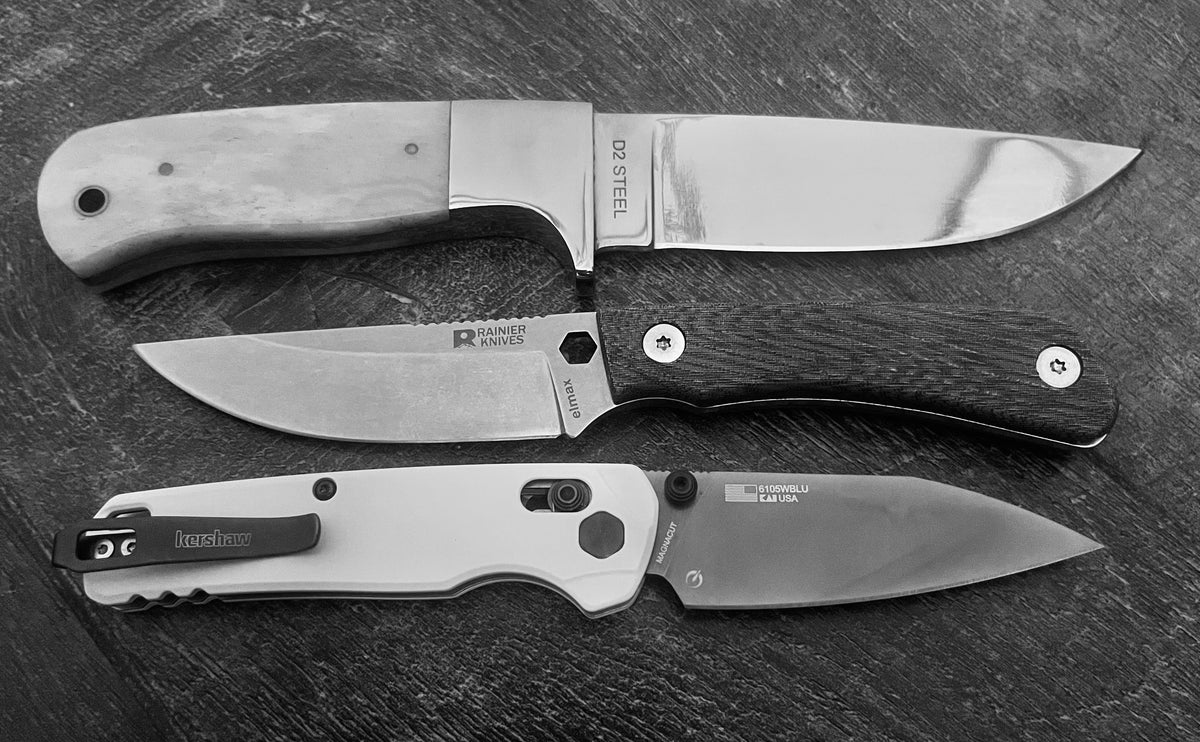
If you have spent any time shopping for a quality folding knife, you have run into these three steel names repeatedly. MagnaCut, S35VN, and D2 show up on knives ranging from $45 to $300, and the marketing around each one can make it sound like the best steel ever made. The reality is more nuanced — each has genuine strengths and real tradeoffs, and the right choice depends on how and where you carry your knife.
Here is a clear breakdown of all three so you can make an informed decision without needing a metallurgy degree.
What Knife Steel Actually Does
Before comparing steels, it helps to understand what you're actually evaluating. Knife steel performance comes down to four properties:
Edge retention — How long the blade stays sharp before it needs touching up. Higher is generally better for heavy use, but extremely hard steels can be brittle.
Toughness — The steel's resistance to chipping, cracking, or breaking under lateral stress or impact. Important if your knife might contact bone, hard materials, or be used for prying.
Corrosion resistance — How well the steel resists rust, staining, and pitting from moisture, sweat, blood, or salt water. Critical for hunting knives, outdoor use, or humid climates.
Sharpenability — How easy the steel is to bring back to a sharp edge. Harder steels with more carbides hold an edge longer but take more effort to sharpen.
These four properties are constant tradeoffs against each other in different types of steel. Historically, a steel that excelled at edge retention gave up toughness. A steel with great corrosion resistance struggled with edge retention. The entire history of knife steel development is engineers trying to push all four properties up at the same time.
D2 Tool Steel
D2 is a high-carbon, high-chromium tool steel that has been used in knives for decades. It's sometimes called semi-stainless because its chromium content (around 11.5%) is close to but below the 13% threshold that's generally considered true stainless steel.
Edge retention: Excellent
D2 has a high volume of chromium carbides that give it outstanding wear resistance. A D2 knife holds its edge through demanding cutting tasks noticeably longer than most entry-level stainless steels.
Toughness: Moderate
D2 is harder and more wear-resistant than many stainless steels, but that hardness comes at a cost. It can chip if used for prying or if it contacts hard materials at the wrong angle. It's not a brittle steel, but it's also not the most forgiving either.
Corrosion resistance: Moderate — watch this closely
This is D2's biggest weakness for many users. With 11.5% chromium it has better rust resistance than plain carbon steel, but it will stain and rust if exposed to moisture, sweat, or blood and left uncleaned. If you carry a D2 knife for hunting or outdoor use you need to wipe it down and oil it after use. Leaving it wet overnight is a problem.
Sharpenability: Moderate — needs quality stones
D2's high carbide volume means standard aluminum oxide whetstones do not cut it efficiently. You will want diamond plates or ceramic rods to get the best results. It takes more effort than budget stainless but holds the edge longer once there.
Best for: EDC in dry conditions, users who maintain their gear diligently, anyone wanting premium edge retention without paying premium steel prices. The Ontario RAT 1 in D2 is one of the best values in the knife world for a D2 folder.
Not ideal for: Hunting, wet environments, saltwater exposure, or anyone who wants low-maintenance carry.
CPM S45VN
S45VN is Spyderco's current standard steel for the Para 3 and Para Military 2 lines and represents the latest refinement in a lineage that began with S30V and was updated to S35VN. Developed collaboratively by Crucible Industries and Spyderco, S45VN improves on its predecessor S35VN primarily in toughness — a meaningful upgrade for a steel that was already well regarded in the industry.
S45VN achieves its toughness improvement through a refined carbide structure compared to S35VN. The addition of niobium (borrowed from MagnaCut's chemistry) helps refine the vanadium carbide distribution, producing a more homogeneous microstructure that is more resistant to chipping under lateral stress. The result is a steel that is measurably tougher than S35VN while maintaining the edge retention and corrosion resistance that made that steel the production standard for nearly a decade.
Edge retention: Very good. S45VN holds an edge through typical everyday carry tasks and light to moderate field use confidently. It does not match MagnaCut for absolute wear resistance, but the gap is not dramatic in real-world use, and most carriers will find S45VN's performance entirely satisfying across its full range of intended tasks.
Toughness: Good to very good, and meaningfully improved over S35VN. The niobium addition and refined carbide structure give S45VN enough impact resistance for the demanding use cases that the Para Military series attracts — hard use EDC, outdoor work, and field tasks — without the brittleness concerns of more highly alloyed wear-resistant steels.
Corrosion resistance: Good. S45VN is a true stainless steel with 16% chromium and handles typical moisture exposure, occasional saltwater contact, and everyday carry without requiring constant maintenance. It is less corrosion resistant than MagnaCut and should not be subjected to the extended marine or hunting conditions that MagnaCut handles without concern, but for most EDC use it is entirely adequate.
Ease of sharpening: Moderate and predictable. S45VN responds well to diamond and ceramic stones and produces a refined, keen edge that strops back easily between full sharpenings. It is slightly harder to sharpen than earlier S-series steels but the improved edge retention means fewer sharpening sessions overall.
Who it is for: The broadest category of EDC users — people who want a premium, American-made steel with excellent all-around performance and long-term reliability without a specific niche requirement. S45VN is the default premium EDC steel choice for good reason: it does everything well without meaningful compromise.
Typical hardness: 59–61 HRC
Price point: Premium, though typically slightly more accessible than MagnaCut-bearing models
CPM MagnaCut
MagnaCut is the newest of the three steels covered here. It was designed by metallurgist Dr. Larrin Thomas and introduced in 2021, produced by Crucible Industries using their powder-metallurgy process. Thomas specifically set out to break the historical tradeoffs in knife steel — to produce a steel with outstanding corrosion resistance, outstanding edge retention, AND outstanding toughness simultaneously. Independent testing and real-world use have largely validated that goal.
Edge retention: Very high
MagnaCut's edge retention exceeds S35VN and approaches the best tool steels, while remaining a true stainless. In practical cutting tests it consistently outperforms S35VN and runs well ahead of D2 in long-term retention.
Toughness: Very good
MagnaCut matches or exceeds S35VN in toughness — a remarkable achievement given its high edge retention. The combination of high edge retention and high toughness in the same steel is genuinely unusual and is the technical breakthrough that made MagnaCut as popular as it is today as THE premium knife steel.
Corrosion resistance: Exceptional — best of these three by a wide margin
MagnaCut was specifically engineered to maximize corrosion resistance. Independent electrochemical testing found it performs better than most traditional stainless knife steels. For any application involving blood, salt water, sweat, or wet environments — hunting, fishing, maritime use, hard outdoor work — MagnaCut is the clear leader. You'll notice that our initial stock of inventory is very selective across just a handful of knife models from the Ontario Knife Company and Spyderco, and they all have MagnaCut in common. Particularly the Salt Series Spyderco models that we carry (the Para Military 2 in Black DLC, the Para Military 2 in Yellow/Black, and the Para 3 Lightweight) use MagnaCut specifically for this reason.
Sharpenability: Moderate — similar to S35VN
MagnaCut is not difficult to sharpen relative to its performance level. Diamond stones produce the best results and field touch-ups with a quality ceramic rod are effective. It takes more effort than AUS-8 or 8Cr13MoV but significantly less than the hardest tool steels.
Best for: Hunting and field use, any wet or corrosive environment, users who want the best all-around performance and are willing to pay a premium for it, anyone who hates dealing with rust and staining.
Not ideal for: Budget-conscious buyers — MagnaCut commands a price premium. Knives in MagnaCut typically cost $40–$80 more than comparable knives in S35VN from the same maker.
Side-by-Side Summary
| D2 | S45VN | MagnaCut | |
|---|---|---|---|
| Edge Retention | ★★★★ | ★★★★ | ★★★★★ |
| Toughness | ★★★ | ★★★★ | ★★★★ |
| Corrosion Resistance | ★★ | ★★★★ | ★★★★★ |
| Sharpenability | ★★★ | ★★★★ | ★★★★ |
| Typical Price Tier | Mid | Premium | Premium+ |
Which Steel Should You Choose?
Choose D2 if: You want the best edge retention for the money, you are disciplined about maintenance, and you carry in dry conditions. The Ontario RAT 1 in D2 at around $45 is hard to beat as a value proposition.
Choose S45VN if: You want a genuinely well-rounded premium steel with no serious weaknesses, you hunt or spend time outdoors in mixed conditions, and you want a steel that handles light neglect without immediate consequences.
Choose MagnaCut if: You carry in wet or demanding environments, you hunt and your knife will be exposed to blood and moisture for extended periods, you want the best available performance and are willing to pay for it, or you simply do not want to think or worry about rust.
At EDCustoms we plan to eventually stock knives across all three steels. If you have questions about which steel makes sense for your specific use case, reach out — we are happy to talk it through.